
Lesson 2.3 · Your first session
Where this gets you: you’ll take one small task end-to-end with an agent and understand the loop it runs (the thing every later lesson builds on).
The idea
An agent session is a loop, not one prompt and one answer.
You give it a goal. Then it circles: gather the files it needs, act by making an edit or running a command, check what happened by running the test or reading the error. Then it loops — gather, act, check — until the goal is met or it gets stuck and asks you.
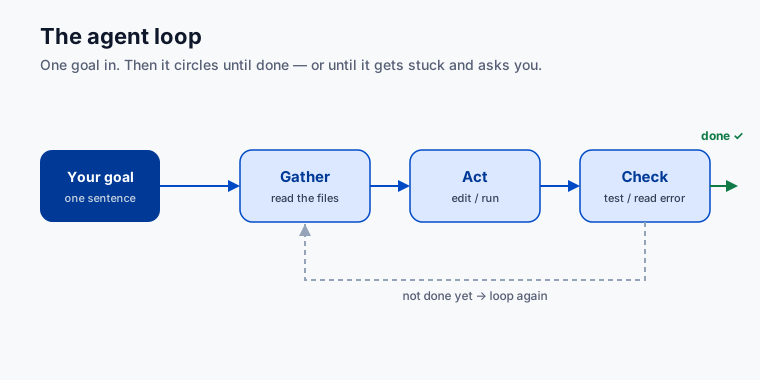
You watch this happen in your terminal. It tells you what it read, what it will change, and what each command printed. Read that stream — it’s where you catch wrong turns early.
Here’s a real one, captured from an actual session. A four-line app.py ends with a bare greet("world"), so the greeting fires on import, not just when you run the file. Nobody asked for that bug to be found — the prompt was only “find one tiny improvement.” The agent read the file (gather), ran it to see the current behaviour (check), guarded the call behind __main__ (act), then ran it again both ways to prove nothing broke (check):
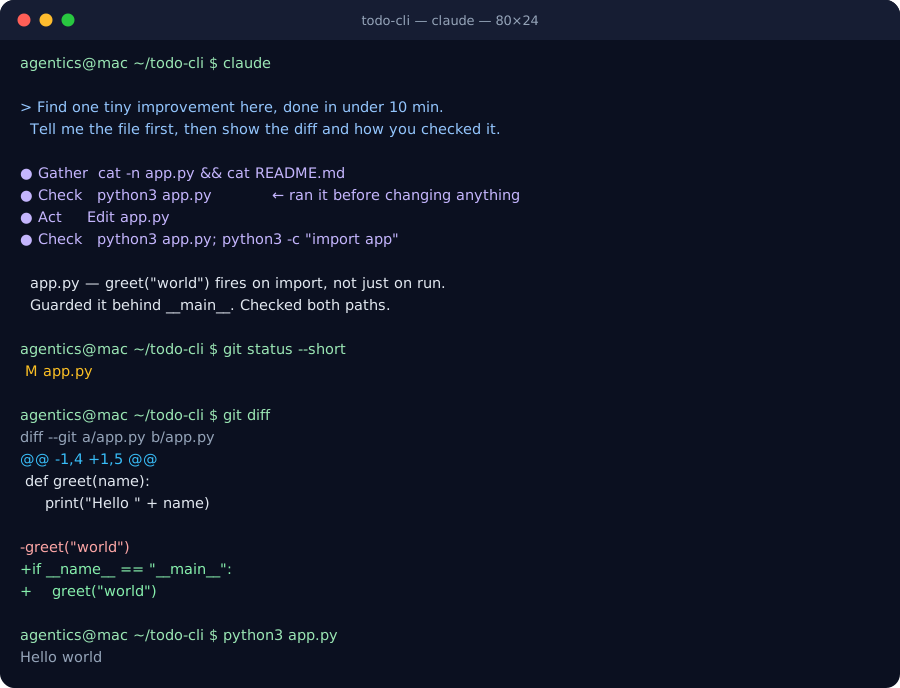
Two things worth noticing. The agent ran the program before editing it — that’s how it knew what “unchanged behaviour” meant. And the last three commands are yours: git status --short, git diff, then run it. That’s you doing the check by hand, on top of the agent’s.
When it heads the wrong way, hit Esc and correct it in plain words: “the config lives in settings/, not the root” or “skip tests for now, just make the change.” It picks up from there with the new information.
Small asks beat one giant prompt. “Rename this function and update its callers” gives the agent a clear target. “Refactor the whole module” gives it room to wander. Scope down; ask for the next piece after you’ve reviewed the last one.
Do it
Open a repo you know and start your tool:
claude
Codex CLI users run codex. Gemini CLI users run gemini. Coco users open the approved workspace for the repo or data product.
Pick something genuinely small. A typo in a string, a renamed variable, one new log line.
Give it the goal in one sentence. Then watch. Don’t touch anything. Read each step as it scrolls by. What file it opened, what it changed, what it ran.
Here is a safe first-session prompt:
Find one tiny improvement in this repo that can be completed in under ten minutes.
Before editing, tell me the exact file you plan to touch and why.
After editing, show me the diff and the command or manual check you used.
If it heads somewhere wrong, hit Esc and type what you meant. Let it finish.
Your exercise
In a repo you know well, give the agent one small, real task. Something you could have done yourself in a few minutes.
Watch the whole loop run without jumping in unless it goes wrong. When it’s done, read every change it made. Open the diff, read each line, make sure you’d have signed off on it yourself.
Use these commands after the agent finishes:
# see every changed file
git status --short

# read the actual patch before accepting it
git diff

# run the smallest relevant check for your project
npm test
# or
pytest
# or
make test
You’re done when you’ve taken one small task end-to-end and can describe the gather → act → check loop in your own words.
Practice proof: save the prompt you gave, the diff it produced, and the command or manual check you used to verify it. Fresh graduates should ask a human or teammate to review this first diff if possible.
Build on it: build a small script that reads a saved session transcript and prints each step tagged gather, act, or check, so wrong turns stand out.
Why this matters
Everything later in this course is this loop, scaled up. Bigger tasks, more of them, several at once. If the loop is clear to you on something small, the hard stuff later is just more of a thing you already understand. If it’s a blur now, it stays a blur.
Previous: Lesson 2.2 · Install your tool · Next: Lesson 2.4 · Staying in control